
Back to News
The Plate Is the Policy — Why The Farmer’s Cow® Calfé Aligns with HHS and USDA Priorities
October 6, 2026
Yesterday the U.S. Department of Agriculture announced it is increasing investment in its Regenerative Pilot Program, expanding support for producers who adopt whole-farm practices that improve soil health, water quality, and long-term resilience — and framing that work as part of the Make America Healthy Again (MAHA) agenda. Health and Human Services leadership put it plainly: farmers are on the front line of making America healthy again.
We agree. And we would add one more sentence: health starts on the land, but it has to show up on the plate.
That is what The Farmer’s Cow® Calfé was built to do.
The Farmer’s Cow® is a farmer-owned cooperative platform launched in 2003 by six multigenerational Connecticut family dairy farms. FC Development Corp. is the brand management, development, and expansion partner. While farms focus on production, we operate the consumer-facing businesses that turn stewardship into something a guest can taste — starting with our Calfés in Berlin and Mansfield/Willimantic.
The Calfé as a mission-aligned demonstration site
The health of our food system and the health of our communities rise — or fall — together. That’s the point: a demand that American food systems reconnect health, farmers, and everyday affordability. The Farmer’s Cow® Calfé is a demonstration site for a model that perfectly aligns with national objectives and local consumer priorities:
1. Source intimacy, built honestly.
We do not treat “local” as theater — and we do not claim to be 100% farm-to-table (yet). Our co-op farms’ milk is processed and bottled off-site under The Farmer’s Cow® brand; we use that branded milk, and eggs, across many parts of the Calfé menu. Alongside that brand foundation, we have been continuously strengthening our local-sourcing footprint — featuring seasonal Connecticut ingredients when they are available, and deepening distribution partnerships that open the door to more local farms and artisans. Our partnership with Sardilli Produce & Dairy is one clear example: a third-generation, family-owned Connecticut distributor that expands reliable access to farm-direct produce and specialty items while keeping more of the food dollar close to home. If we can’t get something local, we ensure it’s of high quality and high standards. That is regenerative economics in practice — more producers in the story, more resilience in the supply chain, more authenticity a guest can trust — without overstating what is on the plate today.
2. Scratch-made, fresh kitchen process.
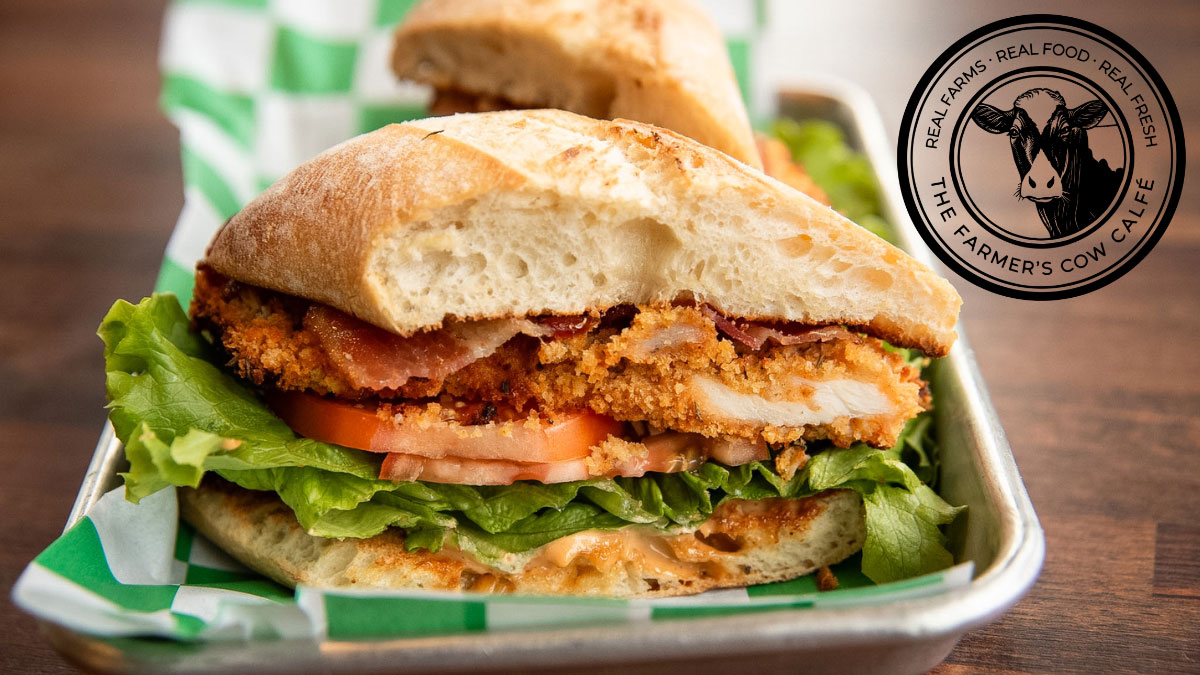
Our kitchens are built around fresh-made, scratch processes — food prepared with care, not assembled from industrial shortcuts. Guests get speed without surrendering the soul of the meal. That “fast quality” standard is how farm integrity survives the lunch rush.
3. Value positioning that invites people in.
Healthy, farm-connected food fails if only a narrow audience can afford it. Our Calfés are positioned for real value — thoughtful ingredients and transparent sourcing at a price point meant for everyday community use, not occasion-only dining. If the goal is about making America healthy again, an aligned model must be accessible, repeatable, and scalable — not precious.
Put those three together and the Calfé is more than a restaurant. It is a working demonstration of priorities that are elevating nationally: loyalty to family farms, connection between land and plate, and food systems ordinary Americans can actually use.
Why the USDA announcement matters to us
USDA’s expansion of regenerative support further exemplifies this administration’s commitment to family farms and U.S. agriculture as a whole. That commitment validates what we have been building for years: loyalty to the land and to the family farmer is not nostalgia — it is national strategy.
Regenerative practice on the farm and regenerative experience at the Calfé are the same continuity. Soil health, animal stewardship, and honest local sourcing are upstream. Scratch-made meals at a fair price are downstream. Clean energy development and licensing, and premium retail that carries the co-op into grocery channels, extend that continuity beyond the dining room. We call the full stack a Family Farm Security Ecosystem — dairy-rooted, expandable to more producers, and deliberately designed so consumer demand strengthens farm viability instead of extracting from it.
Conversations that keep building
Over the past year, conversations with national and state representatives — including an invitation to visit USDA headquarters in Washington and continued dialogue with USDA Rural Development and other partners — have been building around how a farmer-owned brand platform, Calfé dining, retail, and clean energy can support family-farm viability, and the communities around them, in a durable way.
What we can say plainly is this: the work on the ground in Connecticut keeps advancing, the dialogue continues, and we invite more of it — more listening, more alignment, and more partnership opportunities with those who share the goal of putting American farmers first.
To our community of supporters, partners, fellow farmers, and forward-thinking neighbors: we are grateful to walk this path with you. Your belief in resilient, mission-driven food systems fuels everything we do. We welcome your thoughts — and we look forward to sharing more as we advance this shared vision.
Source: USDA, “USDA Increases Investment in Regenerative Pilot Program to Lower Farmer Production Costs and Advance MAHA Agenda,” September 29, 2026.
https://www.usda.gov/about-usda/news/press-releases/2026/09/29/usda-increases-investment-regenerative-pilot-program-lower-farmer-production-costs-and-advance-maha
Related public context (local supply chain): FC Development Corp. and The Farmer’s Cow® partnership with Sardilli Produce & Dairy, April 24, 2026.
https://fcdevcorp.com/fc-development-corp-and-the-farmers-cow-partner-with-sardilli-produce-dairy-to-strengthen-local-supply-chain/
Humbly, yet resolutely,
Steve Lane
President
FC Development Corp.
Back to News