
Back to News
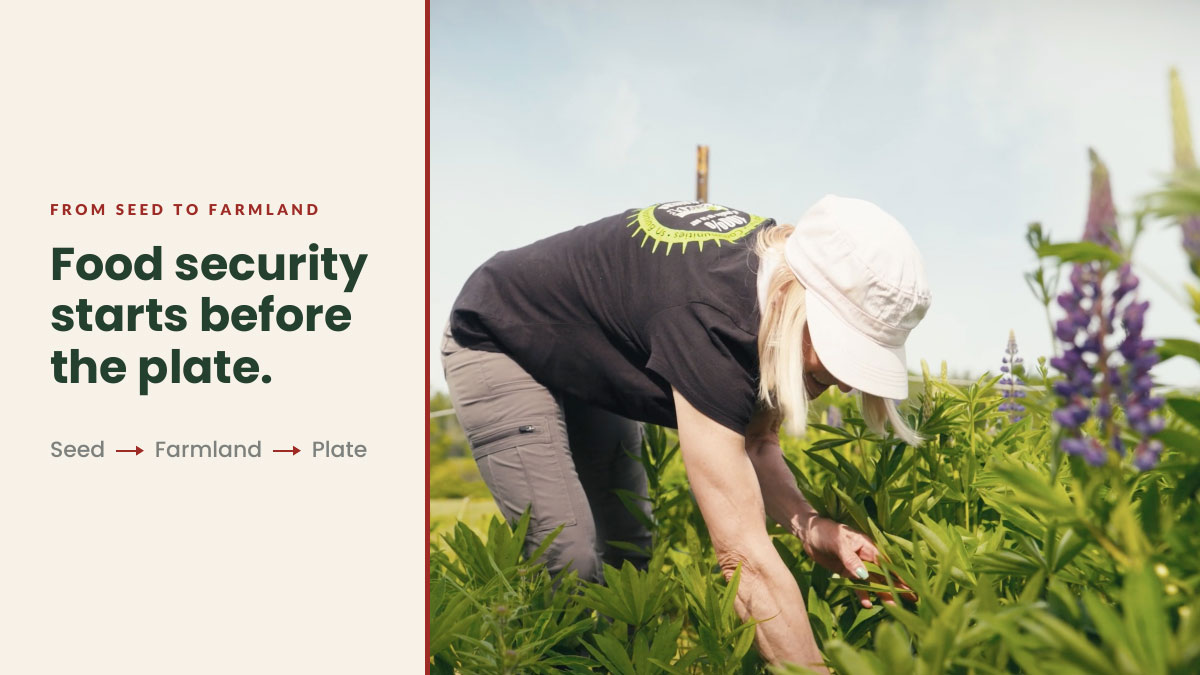
From Seed to Farmland: Food Security Starts Before the Plate
October 16, 2026
Most conversations about food security start at the grocery aisle. Prices, shelves, supply. That’s where we feel it. But by the time food reaches a shelf or a plate, most of the decisions that determine whether it gets there were made months or years earlier, upstream: in the seed, and on the land.
Two stories this month make that case better than I could on my own. One is about seeds. The other is about farmland, and what happens to it when it changes hands. Read together, they describe one chain, and they pick up where our recent piece, The Plate Is the Policy, left off.
One. The Seed.
On October 6, Agriculture Secretary Brooke Rollins announced a $180 million Seed Sovereignty Initiative. The funding goes to USDA’s National Plant Germplasm System, which holds more than 600,000 seed and plant samples from over 16,000 species, so that USDA can sequence those collections.
Secretary Rollins put it plainly: “we cannot afford to depend on foreign adversaries for next year’s crop.”
Deputy Secretary Stephen Vaden framed it in national-security terms: America’s agricultural resources are “a strategic national asset.”
USDA is also expanding its agreement with the Justice Department on competition in farm input markets, with a continued emphasis on seeds.
That matters because food security doesn’t start at the farm gate, let alone the checkout line. It starts with inputs: the genetic material behind next year’s planting decisions, and the competitive markets that decide what farmers can actually buy. If those inputs are concentrated, fragile, or dependent on someone else, everything downstream inherits that weakness.
Two. The Land.
Seeds need ground. And the ground itself is in the middle of a generational handoff.
Connecticut Farmland Trust recently raised a question worth sitting with: what happens when farmland is passed down to someone who isn’t a farmer? CFT shared Kristen Schmitt’s Offrange piece, “So You Inherited a Farm,” which lays out the scale.
According to the Land Trust Alliance, roughly 40% of American farm and forest land is owned by people 65 and older, and more than 370 million acres are expected to change ownership by 2040. With national cropland averaging roughly $6,000 an acre (American Farm Bureau), selling is tempting.
The story follows Curt Craig, a retired school superintendent who inherited his family’s 1893 Indiana farm with his sister. They’re working with a mediator and enrolling some acreage in conservation programs. In his words: “the farm is really a stability that’s going to be there.”
That’s the human side of the statistic. Hundreds of millions of acres won’t change hands in a single transaction. They’ll change hands one family, one kitchen-table conversation, one decision at a time.
What keeps land in farming?
In Connecticut, one answer is the agricultural conservation easement. As CFT explains, it’s voluntary, permanent, and runs with the land. Owners keep the land and can still sell, lease, or pass it to heirs. Because value reflects agricultural use rather than development pressure, conserved land is often more affordable for beginning farmers.
CFT shares an example from Lebanon, Connecticut: a farm conserved in 2011 was later bought by new farmers Cyril and Lindsay Green of Stoneboat Farm, who could afford it because of the easement.
That’s the whole argument in one farm. Protection didn’t freeze the land. It kept it within reach of the next generation of farmers.
American Farmland Trust’s Jerry Cosgrove, quoted by Offrange, described easements as protecting land “for agriculture and not from it.” I keep coming back to that phrase. The goal isn’t to preserve farmland as scenery. It’s to keep it working.
Three. The Plate.
Here’s where the chain closes. Every plate depends on a farmer who had access to good seed and to land they could afford to farm. Break the seed link and farmers lose choice and resilience. Break the land link and the farmer disappears from the picture entirely, replaced by a subdivision or a parking lot. Either way, the plate eventually feels it.
We tend to treat these as separate policy silos: research funding over here, land conservation over there, food prices somewhere else. Families who farm don’t experience them separately. A dairy or vegetable farm lives inside all three at once: what it can plant or feed, whether the land stays in agriculture, and whether there’s a market on the other end.
The Lens. Family Farm & Food Security.
At FC Development Corp, we look at all of this through what we call the Family Farm Security Ecosystem, the worldview behind our American Food Security Platform, and it’s already here – and building daily. It’s a simple idea: family farms and domestic agricultural capacity are infrastructure, not nostalgia. Seed → farmland → plate is one chain, and farmland is infrastructure, not inventory.
That lens doesn’t mean we’re part of every program I’ve described here. We’re not. But we have a solution that can add significant value for hundreds, and eventually, thousands of farms nationwide – and it’s already in motion. USDA’s initiative, Connecticut Farmland Trust’s easement work, and the families in these stories stand on their own as part of the greater story. What the lens does is help us see the connections, and ask a better question than “what does food cost today?” The better question is: will the farms that grow it still be here, still farming, still able to plant what they choose, a generation from now, and how do we champion that mission?
Seed sovereignty answers part of that. Farmland protection answers another part. Strong local demand for what family farms produce answers the rest.
— Humbly, yet resolutely,
Steve Lane
President
FC Development Corp.
Sources
– USDA, “USDA Announces $180 Million Seed Sovereignty Initiative to Strengthen U.S. Agricultural Security,” Oct 6, 2026: https://www.usda.gov/about-usda/news/press-releases/2026/10/06/usda-announces-180-million-seed-sovereignty-initiative-strengthen-us-agricultural-security
– Offrange, “So You Inherited a Farm,” Kristen Schmitt, Sep 25, 2026 (Land Trust Alliance and American Farm Bureau figures, Craig and Cosgrove quotes, as cited there): https://ambrook.com/offrange/land/the-accidental-farmowner
– Connecticut Farmland Trust, Conservation & land transfers: https://ctfarmland.org/conservation-and-land-transfers/
– Connecticut Farmland Trust, Conservation benefits: https://ctfarmland.org/conservation-benefits/
– Connecticut Farmland Trust, “Farming Over Generations,” Apr 17, 2026: https://ctfarmland.org/farming-over-generations/
Back to News